


Corporate treasury for startups
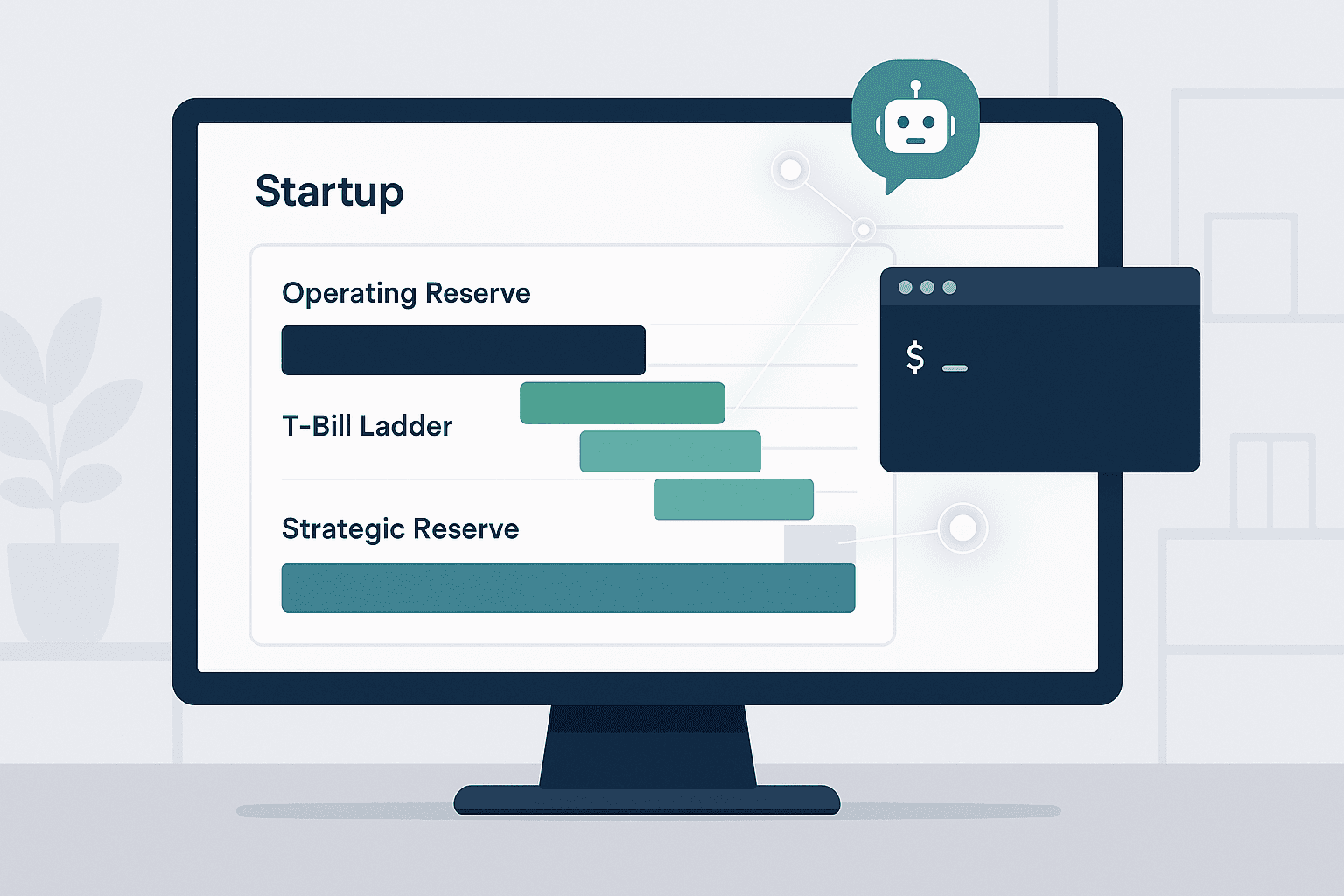
$5 million sitting in a business checking account at 0.01% APY earns $500 a year. That same balance in a 4-week T-bill at yields that have run above 4% in recent rate environments earns roughly $200,000 annually. The delta is roughly $199,500 a year, compounding every quarter it goes unaddressed.
Most growth-stage startups end up here for understandable reasons. A checking account feels safe and accessible, and nobody on the team owns “treasury” (that word sounds like something a Citigroup department handles). So the runway sits idle while interest rates reward everyone who moved theirs.
Corporate treasury at startup scale doesn’t require a dedicated analyst or a Bloomberg terminal. It requires segmenting your cash by when you’ll actually need it, deploying idle reserves into short-duration instruments, and automating the monitoring and execution cycle so it doesn’t consume 10 hours a week.
The cost of doing nothing with your cash
At 0.01% APY, a $5M checking account balance earns $500 annually. At 4% (a figure in the range seen in recent 4-week T-bill yield environments, which you can verify at TreasuryDirect.gov), the same balance earns $200,000. The opportunity cost is $199,500 per year, or roughly $16,600 per month.
The reasons startups leave this money on the table are structural. If funds are tied up in an instrument, can you get to them when payroll hits on Friday? There’s also no one whose job is to think about this. Finance managers at Series A-C companies are typically consumed by AP, reconciliation, and board reporting, so optimizing cash yield doesn’t make the weekly task list.
Most startup banking platforms also don’t make agentic treasury easy. Mercury publishes a developer API, but moving cash into T-bills at a defined threshold today is still a person executing on a rule. None of the major startup banks expose treasury actions as something an AI agent can call directly.
Treasury management becomes tractable at startup scale once you treat it as a segmentation, automation, and overhead-reduction problem, and getting those three right is what drives the yield.
Cash positioning with the three-bucket model
Startup cash management works best when you divide your balance into three buckets, each with a distinct liquidity horizon and a correspondingly different yield target.
Bucket 1 (Operating Reserve, 30–60 days of burn). This cash lives in your primary checking account. It covers payroll, SaaS subscriptions, vendor payments, and any unexpected operating need without friction or settlement delay. Don’t chase yield here. The cost of a payment failing because funds are in settlement exceeds any APY differential you’d gain from investing this tranche.
Bucket 2 (Near-Term Deployable, 3–6 months of runway). Size this to cash you won’t need for at least 90 days but want accessible within a quarter if growth accelerates or burn increases. Four-week and 13-week T-bills fit here, maintaining liquidity at regular intervals while earning meaningfully more than a checking account. Money market funds work as an alternative if you want daily liquidity, though at a yield discount.
Bucket 3 (Strategic Reserve, 6+ months of runway). Once your runway clears six months, the excess is genuinely idle in the medium term. 26-week and 52-week T-bills make sense here, or an investment-grade (IG) bond fund if you’re comfortable accepting slightly more duration risk for higher yield. The instrument choice depends on your forecast confidence. How certain are you that this cash won’t be needed in the next 12 months?
The mistake most startups make is collapsing all three buckets into a single account and treating the entire balance as operating cash. The practical rule is that cash moves up a tier once the tier below it is fully covered. If your 13-week burn forecast leaves your operating reserve untouched, any cash above that floor moves to Bucket 2. If Bucket 2 then covers more than six months of runway, the excess moves to Bucket 3. The logic is deterministic enough to encode in an agent workflow, covered in the automation section below.

T-bill laddering: mechanics and setup
T-bill laddering staggers purchases across multiple maturities so a portion of the portfolio rolls every few weeks. A $3M position might split into $750K in 4-week T-bills, $1M in 13-week T-bills, and $1.25M in 26-week T-bills, which keeps a share of the portfolio liquid on a rolling basis rather than locking the full balance into a single 26-week T-bill for six months. As each tranche matures, you either reinvest at the same duration or sweep back to checking, depending on your current cash position.
The practical effect is that you’re never more than four weeks away from a meaningful portion of your portfolio becoming liquid, without holding any of it idle in a 0.01% checking account.
T-bills suit short-duration treasury management because of duration risk. When rates move, shorter-duration instruments experience smaller mark-to-market price changes. A 52-week T-bill has lower price sensitivity than a 3-year IG bond when yields shift. For a startup treasury function without a dedicated risk manager, staying under 12 months in duration limits the downside if you need to exit a position before maturity. TreasuryDirect.gov publishes current auction schedules, maturity terms, and live yields for 4-week, 8-week, 13-week, 17-week, 26-week, and 52-week T-bills, so verify current rates there before making allocation decisions.
T-bills on Meow are held through Meow Advisory LLC, an SEC-registered investment adviser, via Atomic Brokerage LLC, with clearing and custody through BNY Mellon Pershing. That custody chain means your assets aren’t commingled with Meow’s operating funds, and BNY Mellon Pershing is part of BNY Mellon, one of the largest custodians globally.
At the point of purchase in the Meow Dashboard, you set an auto-roll preference. Roll the principal into a new T-bill of the same duration at maturity, or sweep back to your connected checking account. For Bucket 2 cash with no near-term need, auto-roll keeps the position deployed without manual intervention at each maturity date. For Bucket 3 cash that you might want to redeploy differently at maturity, sweeping to checking preserves that optionality.
Beyond T-bills, Meow also offers commercial paper and a Liquid Treasuries product for different risk and liquidity profiles, plus the IG Bond Fund for longer-duration exposure. T-bills are the natural starting point for Bucket 2, and the IG Bond Fund becomes relevant when Bucket 3 is large enough that the duration tradeoff is worth the yield pickup.

FX management for globally distributed operations
FX exposure accumulates gradually. You hire contractors in Poland, a design agency in Portugal, and a QA team in the Philippines. Each individual payment is manageable, but collectively you’re executing a dozen cross-currency transactions a month, and the exchange rate risk, fee drag, and administrative overhead compound as headcount grows.
FX risk becomes material when you’re paying recurring expenses in non-USD currencies, receiving revenue in EUR, GBP, or other currencies, or operating entities in multiple jurisdictions with separate functional currencies.
If you have EUR-denominated payables and EUR-denominated receivables from European customers, match them in the same currency where possible. A startup with €50K in monthly contractor costs and €70K in European ARR has a natural EUR hedge that removes most of its conversion exposure, with no instrument required. It’s uncommon for founders to structure it this way, but it’s the lowest-cost FX risk reduction available.
For payments that can’t be naturally hedged, Meow supports two options:
- Meow processes low-fee international FX wire payments across 50+ currencies, with currency conversion handled automatically. Choose this when the counterparty requires local currency delivery, as a contractor in Warsaw expects PLN to arrive in their account.
- Meow integrates Bridge’s Orchestration API to send and receive USDC directly from existing Meow cash balances. For counterparties who can accept stablecoins, a USDC transfer bypasses FX conversion entirely, sending USD-denominated stablecoins that they receive with no conversion delay. Meow’s partnership with BVNK extends this further, adding access to the Swift network and multiple stablecoin currencies for more complex cross-border payment structures.
Use FX wire when the counterparty requires local currency delivery. Use USDC when they can accept stablecoins and conversion fees would meaningfully erode your margin. At a 1.5% FX spread, a $15,000 international payment costs $225. Across 20 such payments a month, that’s $54,000 annually in conversion fees alone. Moving even a portion of your contractor base onto stablecoin-accepting payment rails recovers most of that.
Automating treasury decisions with AI agents
Manual treasury monitoring doesn’t break all at once. You start with one checking account, then add a T-bill position, then a Liquid Treasuries account, then a second entity with its own balance, and then an international entity with FX exposure. Each addition is individually manageable, but collectively they require daily attention, balance cross-referencing, and decision-making that doesn’t fit cleanly into anyone’s existing role, unless you have a dedicated corporate finance or FP&A function.
Most treasury decisions are rule-based and repetitive. For example, ‘If the checking account balance drops below 45 days of burn, flag it before the next payroll run.’ A properly configured agent tracks that condition against checking balances and transaction history and surfaces it more reliably than a finance manager checking in every other day, catching it the moment it’s true instead of at the next scheduled review. It can also watch for cash landing back in checking, the way a matured T-bill shows up once it sweeps under your auto-roll setting, but it has no way to see the T-bill position itself or know a maturity date on its own.
Meow’s MCP server at mcp.meow.com (also accessible via CLI: npm install -g @joinmeow/cli) exposes balance queries, ACH drafts, and international wire drafts as agent-callable operations. Placing or changing an investment position itself, including a T-bill purchase or its auto-roll setting, is still a dashboard action.
The MCP server implements the Model Context Protocol standard, which means any MCP-compatible client (Claude, ChatGPT, Cursor, Gemini) can connect to live Meow account data and take actions within the permission scope you grant.
Human-in-the-loop
Most teams should start here. Connect Claude or ChatGPT to the Meow MCP server, grant meow.read scope, and begin delegating balance monitoring and payment drafting conversationally.
To connect Claude Code to your Meow account:
1claude mcp add --transport http meow https://mcp.meow.comWith read access configured, you can ask: “Show me the checking account balance and burn rate for each of our entities.” The agent queries Meow in real time and returns the answer. It can tell you what’s sitting in checking, but your T-bill and Liquid Treasuries positions aren’t visible to it. Check those in the dashboard.
When you’re ready to draft a payment, the agent prepares it and records it as a pending draft in the Meow Dashboard. The agent doesn’t execute. You log in, review the details, and approve. The agent handles the preparation work while you control execution.
This model suits teams that want AI assistance without full delegation. The agent removes the lookup and drafting overhead while you retain every approval.
Agent-in-the-loop
For rule-based, recurring transfers, a fixed monthly contractor invoice, or an ACH sweep once a checking balance crosses a defined threshold, you can enable meow.transfers scope and let the agent execute within guardrails you configure. Investment decisions, T-bill auto-roll and sweep preferences included, are set in the Meow Dashboard at the point of purchase. The agent’s role there is limited to monitoring balances and maturity dates and flagging when a change is due, while placing or modifying the trade stays a dashboard action.
Those guardrails operate at the entity level, including a daily spend cap, a per-transaction limit, and rules like requiring a second human approver on any wire over $10K. That approver requirement applies equally to agents and to humans using the dashboard, so the same control that protects against an unauthorized human transaction protects against an agent executing outside its intended scope.
Before enabling transfers, read meow.com/skills.md. It’s a structured skills manifest that teaches your LLM client exactly how to interact with the platform, which operations are available, what parameters each expects, and how to parse responses. Going through it before your first agent session prevents most configuration mistakes.
The security model
Meow scopes and monitors agent access through four mechanisms:
- Identity verification runs through Plaid’s flow, and account data returned by the MCP server excludes personally identifiable information from the payloads sent to the LLM.
- Each agent gets its own API key with independent permissions, passed via the x-api-key header. One agent can hold meow.read for monitoring while a separate agent holds meow.transfers for execution, operating on the same account with independent scopes.
- Agent-initiated transactions go through the same SOC 2 compliance controls as human-initiated ones. Meow’s SOC 2 report is available to technical buyers at trust.meow.com.
- You can revoke any agent’s API key from the Meow Dashboard immediately, with no waiting period.
Start with meow.read scope, confirm the agent can query your checking account balance and pull transaction history correctly before enabling meow.transfers. That ten-minute read-only verification surfaces any configuration issues before they have financial consequences.

Frequently asked questions
What is the three-bucket model for startup cash management?
The three-bucket model divides your total cash balance by liquidity horizon. Bucket 1 (30–60 days of burn) stays in your checking account for operating needs. Bucket 2 (3–6 months of runway) goes into 4-week or 13-week T-bills for near-term yield. Bucket 3 (6+ months of runway) goes into 26-week or 52-week T-bills or an IG bond fund for maximum yield on genuinely idle cash.
How does T-bill laddering work for a startup treasury?
T-bill laddering splits a cash reserve across multiple maturity dates so a portion of the portfolio becomes liquid every few weeks. A $3M position might be divided into $750K in 4-week T-bills, $1M in 13-week T-bills, and $1.25M in 26-week T-bills. As each tranche matures, you reinvest or sweep to checking based on your current burn rate, keeping the portfolio deployed without sacrificing access to cash.
What is the opportunity cost of leaving startup cash in a checking account?
At 0.01% APY, a $5M checking account balance earns $500 per year. At 4% (a yield range seen in recent 4-week T-bill environments), the same balance earns $200,000. The annual opportunity cost is roughly $199,500, or about $16,600 per month, which is a meaningful fraction of a fully loaded engineering salary.
What is the difference between the supervised and autonomous agent models?
In the supervised model, the agent holds read-only access and prepares payment drafts that a human approves in the dashboard before execution. In the autonomous model, the agent holds transfer permissions and executes rule-based transactions within configured guardrails, such as a daily spend cap or a requirement for a second human approver on wires above $10K.
How does Meow handle FX payments for startups with international contractors?
Meow processes international FX wire payments across 50+ currencies with automatic currency conversion, suitable when a contractor requires local currency delivery. For counterparties who can accept stablecoins, Meow integrates Bridge’s Orchestration API to send USDC directly from existing cash balances, bypassing FX conversion entirely. Meow’s partnership with BVNK adds access to the Swift network and multiple stablecoin currencies for more complex cross-border structures.
Is startup cash held in T-bills through Meow protected from commingling?
T-bills purchased through Meow are held via Meow Advisory LLC (an SEC-registered investment adviser) through Atomic Brokerage LLC, with clearing and custody at BNY Mellon Pershing. That custody chain keeps your assets separate from Meow’s operating funds. Meow’s SOC 2 report is available at trust.meow.com for technical buyers who want to review the compliance controls.
Start building your treasury stack today
Building your treasury stack doesn’t require a migration project. Meow sits as a yield-earning layer on top of your existing checking account, adding treasury functions alongside your primary bank.
1. Apply at meow.com. Meow supports LLCs, C-Corps, and S-Corps. Have your EIN and business formation documents ready. KYC runs through Plaid’s identity verification flow, which you’ll complete once during onboarding.
2. Connect your existing bank account via Plaid. This establishes the ACH link for moving cash between your primary checking and Meow. The connection takes a few minutes. Meow’s partner banks (Cross River Bank and Grasshopper Bank, N.A., both FDIC members) handle the deposit side.
3. Move your idle cash. Transfer any balance you won’t need in the next 30–60 days into Meow. This is your Bucket 2 and Bucket 3 allocation.
4. Choose your investment type. For Bucket 2 (3–6 months of runway), select 4-week or 13-week T-bills. For Bucket 3 (6+ months), select 26-week T-bills or the IG Bond Fund depending on your duration preference. Check current yields at TreasuryDirect.gov before deciding.
5. Set your auto-roll preference. At the point of purchase, choose “roll into new T-bill” to keep the position deployed at maturity, or “sweep to checking” to recover liquidity. For Bucket 3 cash with no near-term claim on it, auto-roll is the natural default.
For agent automation, install the CLI and connect your LLM client:
1npm install -g @joinmeow/cliGenerate an API key from the Meow Dashboard, connect your LLM client to meow.com/mcp, and read meow.com/skills.md before your first session. Start with meow.read scope, confirm the agent can query your Treasury Account balance across entities before enabling meow.transfers.
Open meow.com, apply with your EIN, and move the portion of your balance that covers more than 60 days of operating runway into a 4-week T-bill position today. Every week that cash earns 0.01% while short-term Treasuries yield multiples of that is a decision with a calculable dollar cost, and one that’s entirely reversible at the next maturity date.